Published on July 20, 2026 | Written by Mr. Shifa ur rehman jamali
Last updated: July 20, 2026. Refreshing quarterly.
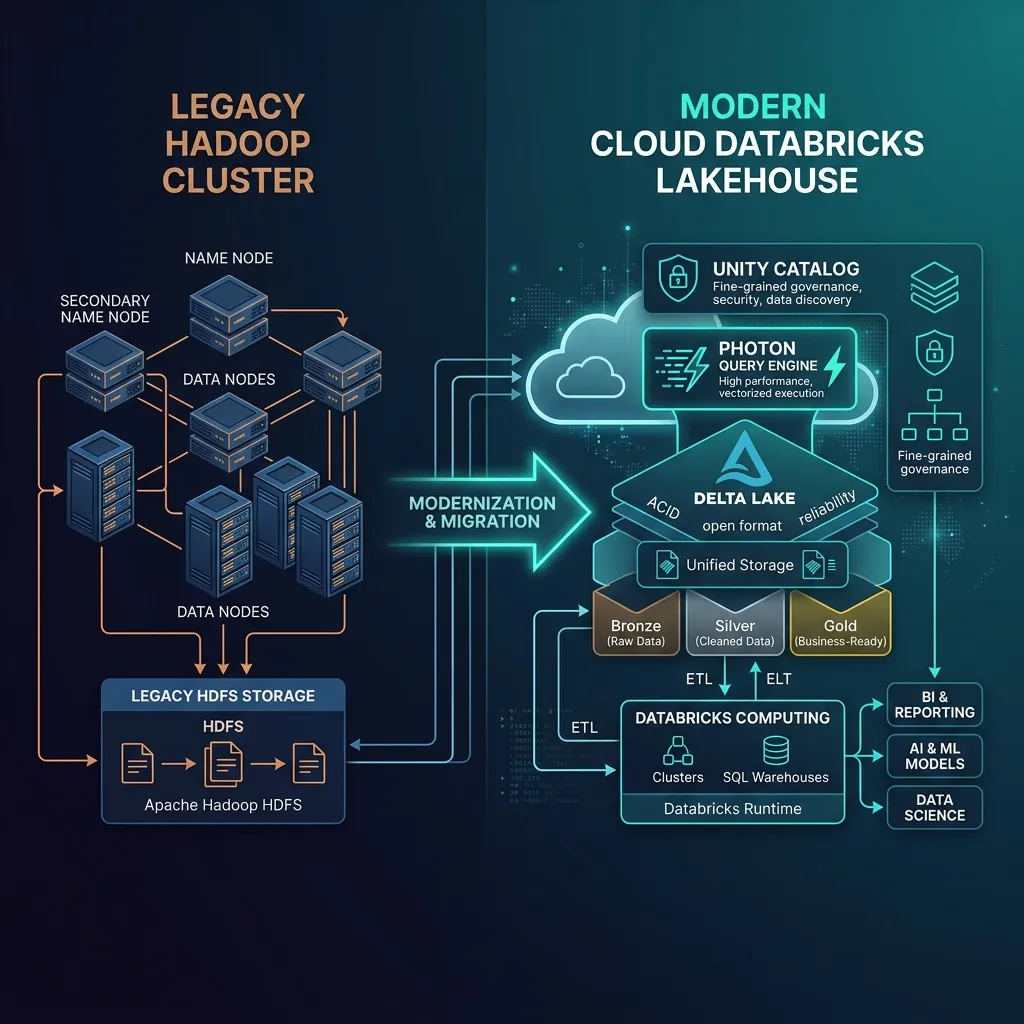
Hadoop isn't dead. Industry analysts still track growth in the broader Hadoop and big-data-analytics market, particularly among regulated enterprises with long data-retention obligations. But growth today is concentrated in hybrid and cloud-adjacent deployments, not fresh on-premises clusters — and for anything new in analytics or AI, Hadoop has quietly stopped being the default starting point.
The shift rarely comes from one dramatic failure. It's cumulative: rising infrastructure cost, a shrinking pool of engineers who want to maintain HDFS and YARN clusters, and — increasingly — the inability to support AI and GenAI workloads without bolting on custom plumbing Hadoop was never designed for.
Enterprise data platforms have moved through four broad eras: the traditional monolithic data warehouse, first-generation Hadoop (cheap storage plus batch compute), decoupled cloud data lakes, and now the lakehouse — a single platform unifying storage, governance, and compute across BI, data science, and AI. Independent Databricks consulting services commonly focus on this transition: establishing Delta Lake as an open table format, Photon as a vectorized query engine, and Unity Catalog as a single governance layer spanning data and AI assets.
The practical reasons Hadoop stops being the default:
If your most ambitious AI or analytics work is already happening outside your Hadoop environment, on a separate cloud stack stitched together with exports and workarounds — your Hadoop platform has already become a legacy anchor, whether or not anyone has said so out loud yet.
Run through each category. You don't need every box checked to justify a migration — three or four consistent signals across different categories is usually enough.
If a major hardware refresh is on your roadmap, that's usually the single clearest inflection point to evaluate a cloud-lakehouse platform migration instead of reinvesting in aging infrastructure.
The single most reliable heuristic across all of this: if your organization's most important AI or analytics initiative is already living outside your Hadoop environment, the decision has effectively already been made — the only open question is timing.
Even when the technology "works," these symptoms tell leadership it's time to modernize:
A useful test for stakeholders: "If we had to ship a new AI-powered feature next quarter, could our current platform support it without a major re-architecture?" If the honest answer is no, the business is already ahead of the platform — and that gap only widens.
Before planning a Hadoop-to-Databricks migration, score your organization (1–5) across each dimension. Low scores aren't blockers — they're your early workstreams.
| Dimension | What "ready" looks like |
|---|---|
| Infrastructure | Full cluster inventory (prod/non-prod/DR), documented capacity trends, known DR patterns, existing cloud connectivity |
| Applications | Catalog of all jobs and workflows, named owners, defined SLAs, known tech-debt hotspots |
| Data | Documented HDFS/Hive datasets, partitions, retention rules, and encryption/masking approach |
| Security & governance | Central identity provider in place, Ranger/Atlas policies exportable, data classification scheme defined, compliance obligations understood |
| Cloud | Landing zone (accounts/subscriptions/projects) defined, standardized security patterns, data residency policy set |
| Network & identity | Documented on-prem↔cloud topology, SSO/SCIM available for future workspace access |
| DR & business continuity | RPO/RTO targets defined, DR tests actually executed and documented |
Your lowest-scoring dimensions become your first workstreams — they constrain how aggressive your migration timeline can realistically be, regardless of how urgent the rest of the business case feels.
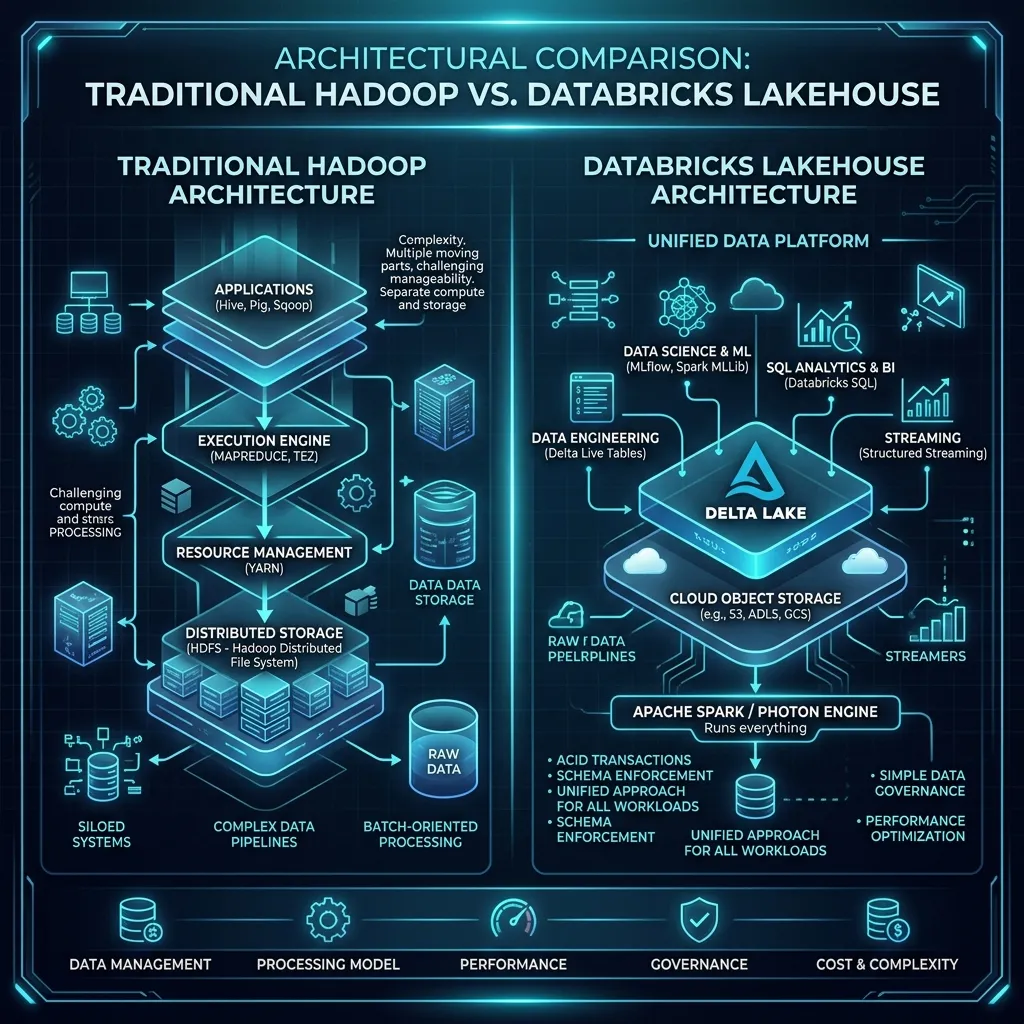
| Dimension | Hadoop | Databricks Lakehouse |
|---|---|---|
| Architecture | HDFS + YARN + multiple engines on fixed clusters | Lakehouse on cloud object storage, decoupled compute, unified governance |
| Storage | HDFS on local disks, often manually synced to object storage | Delta Lake / Iceberg on S3/ADLS/GCS with ACID transactions, time travel, and data skipping |
| Governance | Ranger/Atlas, multiple metastores, fragmented by tool | Unity Catalog as a single governance plane for data and AI assets |
| Compute | Static, YARN-managed cluster sizing | Serverless and cluster-based compute with autoscaling |
| SQL engine | Hive/Impala, variable latency and concurrency | SQL Warehouse with the Photon engine for BI and interactive workloads |
| AI/ML | Separate stacks requiring custom integration | Integrated feature store, MLflow, and vector search tooling |
| Dimension | Hadoop | Databricks |
|---|---|---|
| Scalability | New nodes, rack capacity, and manual rebalancing | Cloud-native autoscaling; workloads scale independently |
| Performance | Dependent on manual HDFS/YARN tuning; MapReduce is inherently slow | Photon engine, optimized Delta layout, dynamic liquid clustering |
| Cost model | Capital-intensive hardware and data-center cost, plus licensing | Pay-as-you-go compute and storage; can scale to zero; serverless options |
| Observability | Mixed open-source tools and custom dashboards | Unified job, cluster, query, lineage, and cost observability |
The medallion pattern. Most Databricks migrations adopt a bronze-silver-gold layered architecture: bronze holds raw ingested data, silver holds cleaned and conformed data, gold holds business-ready aggregates. This replaces the sprawling, ad hoc intermediate Hive tables common in legacy Hadoop pipelines with a single, consistent, and governable pattern.
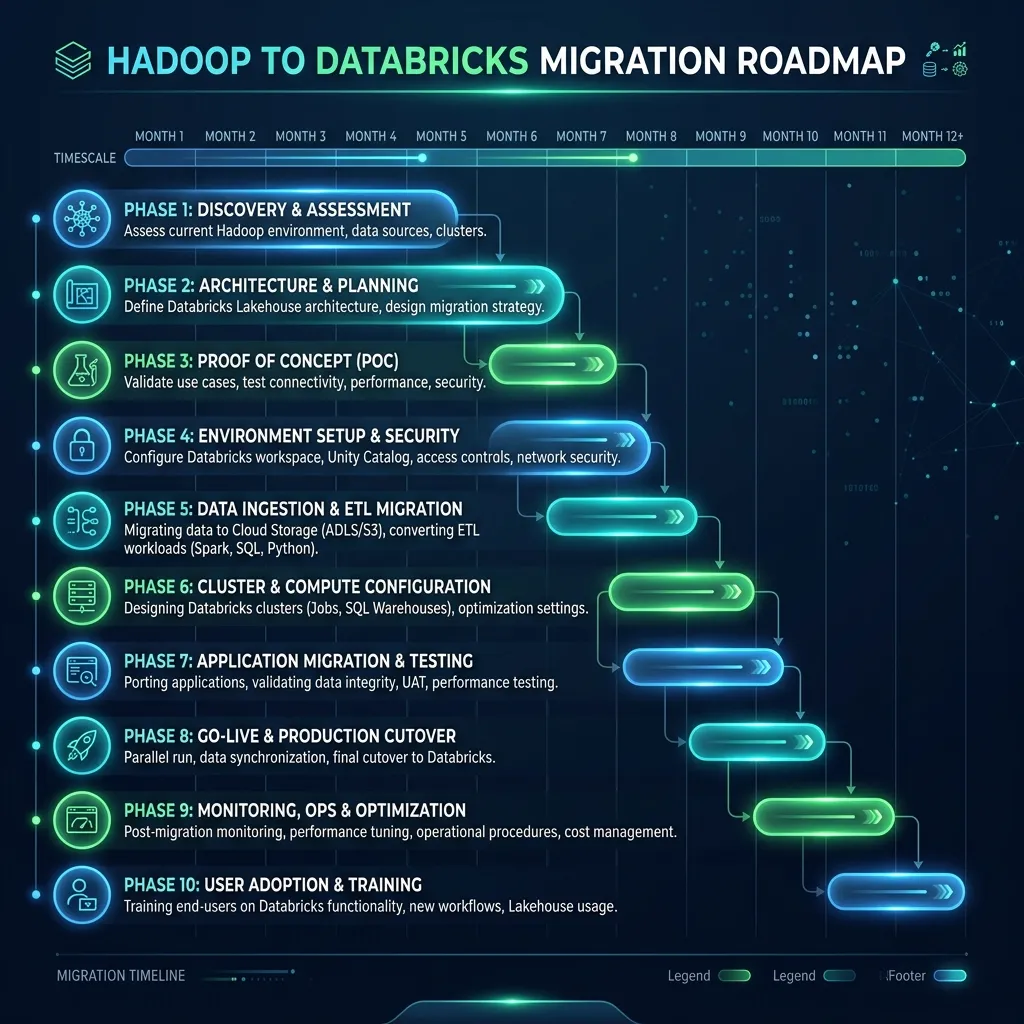
A full migration typically runs through these phases. Treat this as your master data migration checklist — several of these steps deserve their own detailed runbook once you're in execution.
Hive compatibility and Spark version differences. Hive dialect quirks and UDF behavior can break queries after migration. Mitigate with automated query test suites focused on your "canonical" queries per domain, and resist the urge to do a literal one-to-one rewrite — lean into Delta-native patterns like MERGE and OPTIMIZE instead.
Data corruption and permission gaps. Partial writes and inconsistent schemas are common migration failure points. Delta Lake's ACID transactions and schema enforcement directly prevent the partial-write problem; permissions need an explicit, planned mapping from Ranger/ACLs to Unity Catalog grants rather than an assumed one-to-one translation.
Large data transfers with limited downtime. Moving terabytes to petabytes needs a plan, not a weekend. Use incremental bulk-transfer migration tools, archive cold data before migrating it, and run Hadoop and Databricks in parallel through the transition to de-risk cutover migration.
User adoption and legacy dependencies. Teams often resist leaving familiar tools (Hue, Oozie, legacy scripts) because trust is built around what already works. Hands-on enablement and migrating high-visibility dashboards early — so people see the benefit quickly — does more than any policy memo.
Hadoop's total cost of ownership is dominated by capital expenditure (servers, storage, networking, data-center build-out), operating expenditure (power, cooling, floor space, hardware maintenance), vendor software/support subscriptions, and the people cost of specialized Hadoop administrators.
Databricks' cost structure shifts almost entirely to consumption: compute charges (via DBUs) for interactive, job, and serverless workloads, plus object storage — typically priced well below enterprise SAN/HDFS per terabyte. Refer to our Databricks Cost Optimization Guide for a detailed breakdown of DBU and compute tiers.
When building your own ROI model, use a 3–5 year horizon to properly account for migration cost and existing hardware depreciation, and run best/base/worst sensitivity scenarios rather than a single point estimate. Weigh not just infrastructure savings but productivity gains — faster experimentation, shorter development cycles — and the opportunity cost of not being able to ship AI-driven features on your current platform.
Not entirely, and not immediately. Hadoop still fits specific situations: environments with strict data-sovereignty or air-gapped requirements, edge or regional data centers with unreliable cloud connectivity, and organizations running fully amortized clusters with no near-term need for advanced AI.
But for new development, the center of gravity has clearly shifted toward lakehouse and cloud-native platforms, with open table formats (Delta, Iceberg) and unified governance becoming the default expectation rather than a differentiator. The more useful framing for most enterprises isn't "Hadoop or Databricks" — it's how quickly critical workloads can move to an AI-native lakehouse while Hadoop is safely decommissioned or repurposed for what it still does well.
Rising infrastructure and support costs, engineers spending more time on maintenance than new development, performance bottlenecks under normal load, and an inability to support modern AI/GenAI workloads without heavy custom integration.
It depends heavily on cluster size, workload complexity, and how much of your codebase is legacy MapReduce/Pig versus already-modern Spark. Most enterprise migrations run in phases over several months to a year, prioritizing quick wins before tackling mission-critical, high-complexity pipelines.
Yes — this is the more common and lower-risk approach. Most organizations run Hadoop and Databricks in parallel during the transition, migrating workload-by-workload or domain-by-domain rather than attempting a single cutover.
Start with quick wins: low-complexity, high-visibility workloads with few external dependencies, such as a widely used BI dashboard. This proves the pattern and builds organizational confidence before tackling your most complex, mission-critical pipelines.
Not necessarily as a literal one-to-one conversion. Most Hive SQL maps reasonably well to Databricks SQL with syntax adjustments, but it's worth using the migration as an opportunity to adopt Delta-native patterns rather than porting legacy anti-patterns forward.
Unity Catalog consolidates data and AI-asset governance — access control, lineage, and auditing — into a single layer, replacing the fragmented combination of Ranger policies, Atlas metadata, and multiple Hive metastores common in Hadoop environments.
Databricks is built on open formats — Delta Lake and Iceberg support — which reduces lock-in risk compared to proprietary alternatives, though it's still a managed platform rather than fully self-hosted open source. Weigh this against the very real operational lock-in of maintaining Hadoop infrastructure yourself.
Options range from full decommissioning to repurposing it as a cold-archive tier for data that only needs to exist for compliance or rare audits — you don't necessarily need to keep paying for compute capacity you no longer use.
This varies significantly by cluster size and workload complexity — a proper ROI model should compare your current 3–5 year Hadoop TCO (hardware, support, headcount) against projected Databricks consumption costs, factoring in productivity gains, not just infrastructure line items.
Generally no — the lakehouse pattern (Delta Lake plus Databricks SQL Warehouses) is designed to serve BI and warehouse-style workloads directly, removing the need for a separate downstream warehouse in most architectures.
Connect with Shifa ur rehman jamali, Lead Databricks Architect, to evaluate your migration readiness.
Book a Workload Assessment with Cyfra DaneWe provide specialized, independent Databricks consulting without corporate agency markup.