Published on July 28, 2026 | Written by Mr. Shifa ur rehman jamali
Architecture & Infrastructure
A Databricks Lakehouse architecture unifies data lake storage with data warehouse performance and governance in a single platform, built on Delta Lake, Unity Catalog, and Apache Spark. In 2026, this means automated Liquid Clustering instead of manual partitioning, unified governance across data and AI assets, and a semantic layer that finally lets BI and AI teams query the same trusted numbers. This guide walks through the reference architecture, the evolution of the Medallion pattern, and the governance model enterprise teams need to get right before writing a single pipeline.
The core shift in 2026 is that manual performance tuning is disappearing. Legacy practices like directory-based partitioning and hand-managed Z-Ordering are now considered technical debt, replaced by Liquid Clustering and Predictive Optimization, which handle data layout automatically as query patterns change.
This matters for architecture decisions because it removes an entire category of design work — teams no longer need to predict access patterns years in advance and bake them into a rigid partition scheme. Combined with Catalog Commits, which sync Delta transaction logs directly with Unity Catalog metadata, the platform behaves less like a warehouse you configure and more like a system that configures itself around your workload.
UK enterprises sitting on legacy Hadoop or Teradata estates represent the biggest modernization opportunity in the region right now. Shell, for example, manages 1.3 trillion rows of IoT sensor data on Databricks, and HSBC cut analytics processing time for 39 million customers from 6 hours down to 6 seconds. For UK Financial Services and Healthcare organizations specifically, the driving factor is usually not performance — it's that Unity Catalog's column and row-level security model maps cleanly onto FCA and UK GDPR/ICO compliance requirements without needing a bolt-on governance tool.
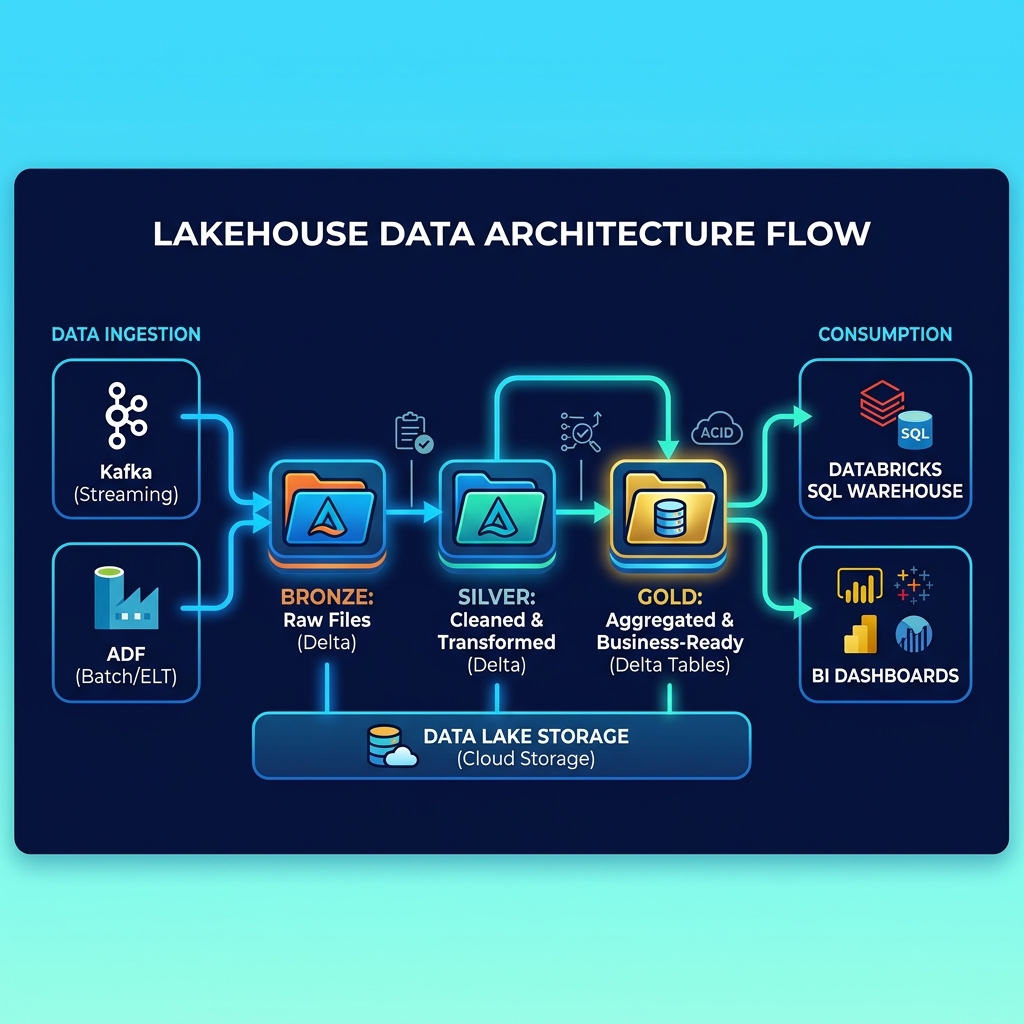
A Databricks Lakehouse reference architecture is typically described in seven swimlanes: Source, Ingest, Storage, Transform/Query, Serve, Collaboration, and Analysis. Each swimlane maps to a specific set of Databricks capabilities, and the architecture is broadly consistent whether you deploy on AWS, Azure, or GCP — the cloud-specific differences show up mainly in networking, IAM, and storage credentials, not in the core Lakehouse design.
| Swimlane | Purpose | Key Databricks Capability |
|---|---|---|
| Source | Origin systems (ERP, CRM, EHR, event streams) | N/A — external systems |
| Ingest | Bringing raw data into the platform | Auto Loader, Lakeflow Connect, Structured Streaming |
| Storage | Durable, versioned data storage | Delta Lake on cloud object storage (S3, ADLS, GCS) |
| Transform/Query | Cleaning, joining, aggregating data | Apache Spark, Photon Engine, Delta Live Tables |
| Serve | Exposing data for consumption | Databricks SQL, Metric Views |
| Collaboration | Shared workspace for teams | Notebooks, Databricks Workflows |
| Analysis | End-user BI and AI consumption | Databricks SQL dashboards, MLflow, Vector Search |
This structure is also the fastest way to explain the architecture to a non-technical stakeholder — it maps almost one-to-one onto "where does data come from, where does it live, how does it get cleaned, and who uses it."

The Medallion architecture — Bronze, Silver, Gold — remains the standard internal structure for organizing data quality within the Storage and Transform layers, though it's a recommended pattern rather than a strict requirement.
What's changed by 2026 is that this pattern now extends into AI readiness. Gold-layer tables increasingly feed feature stores and vector search indexes directly, meaning the same governed pipeline that produces your quarterly revenue dashboard can also produce the retrieval layer for a RAG application — without a separate, parallel data pipeline.

Unity Catalog is the unified governance layer that sits across the entire architecture, controlling access, lineage, and auditing for both data and AI assets in one place. This is the single biggest architectural decision an enterprise makes, because retrofitting governance after pipelines are already built is significantly more expensive than designing for it from day one.
In practice, Unity Catalog governance is built around a three-layer control model:
Unity Catalog also introduces Metric Views, which act as a semantic layer — a single, governed definition of a metric like "monthly active users" that both a BI dashboard and an AI agent can query and get the identical number from.
Liquid Clustering is a dynamic data layout technique that automatically reorganizes data files based on actual query patterns, removing the need for manual partitioning or scheduled Z-Ordering jobs. For tables with concurrent writes and high-cardinality filter columns — the exact scenario where manual partitioning used to break down — Liquid Clustering is now the default recommendation.
The practical impact is cost, not just simplicity: the transition from Z-Ordering to Liquid Clustering has been shown to cut idle DBU spend by up to 30% in real deployments, since the platform no longer needs dedicated maintenance jobs running on a schedule regardless of whether the data layout actually needs adjusting.
A 2026 Lakehouse architecture is judged not just on BI performance but on whether it's ready to support Generative AI workloads without a parallel data stack. Two capabilities matter most here:
It's a unified platform architecture that combines the low-cost, flexible storage of a data lake with the reliability, structure, and performance of a traditional data warehouse, built on open formats like Delta Lake.
Source, Ingest, Storage, Transform/Query, Serve, Collaboration, and Analysis — each representing a distinct stage of data flowing from origin system to end-user consumption.
No. Liquid Clustering has replaced Z-Ordering as the recommended data layout technique for nearly all use cases, since it adjusts automatically rather than requiring scheduled maintenance jobs.
No, but it's strongly recommended. It provides a proven structure for progressively improving data quality (Bronze → Silver → Gold) that also extends naturally into AI feature stores and vector search.
Unity Catalog is Databricks' unified governance layer, controlling access, lineage, and auditing for both data and AI assets across the entire Lakehouse.
No. Databricks doesn't replace your cloud storage — it decouples compute from storage, running its processing engine directly on top of your existing S3, ADLS, or GCS buckets in open formats.
Through column and row-level security, centralized audit logging, and data classification tagging — the same controls needed to satisfy ICO and FCA data handling requirements are native to the governance layer rather than a separate compliance tool.
Getting the reference architecture and Unity Catalog governance model right at the start avoids the single most expensive mistake we see in enterprise Databricks projects: retrofitting governance onto pipelines that were built without it. If you're evaluating a Lakehouse migration or auditing an existing Databricks environment against 2026 best practices, Cyfradane's independent Databricks consulting team can run a full architecture assessment against the reference model above. For teams still deciding on the underlying platform, see our comparison of Databricks vs Snowflake or read what Databricks actually is if you're earlier in your evaluation.