Published on August 1, 2026 | Written by Cyfra Dane Data Engineering Team
Direct Summary: If you're running a legacy on-prem or proprietary cloud data warehouse in a UK enterprise — Teradata, SQL Server, Oracle, or a first-generation Azure Synapse deployment — migrating to Databricks' lakehouse architecture typically cuts storage costs by separating compute from storage, removes the unstructured-data ceiling of your current system, and consolidates BI, ML, and governance onto one platform.
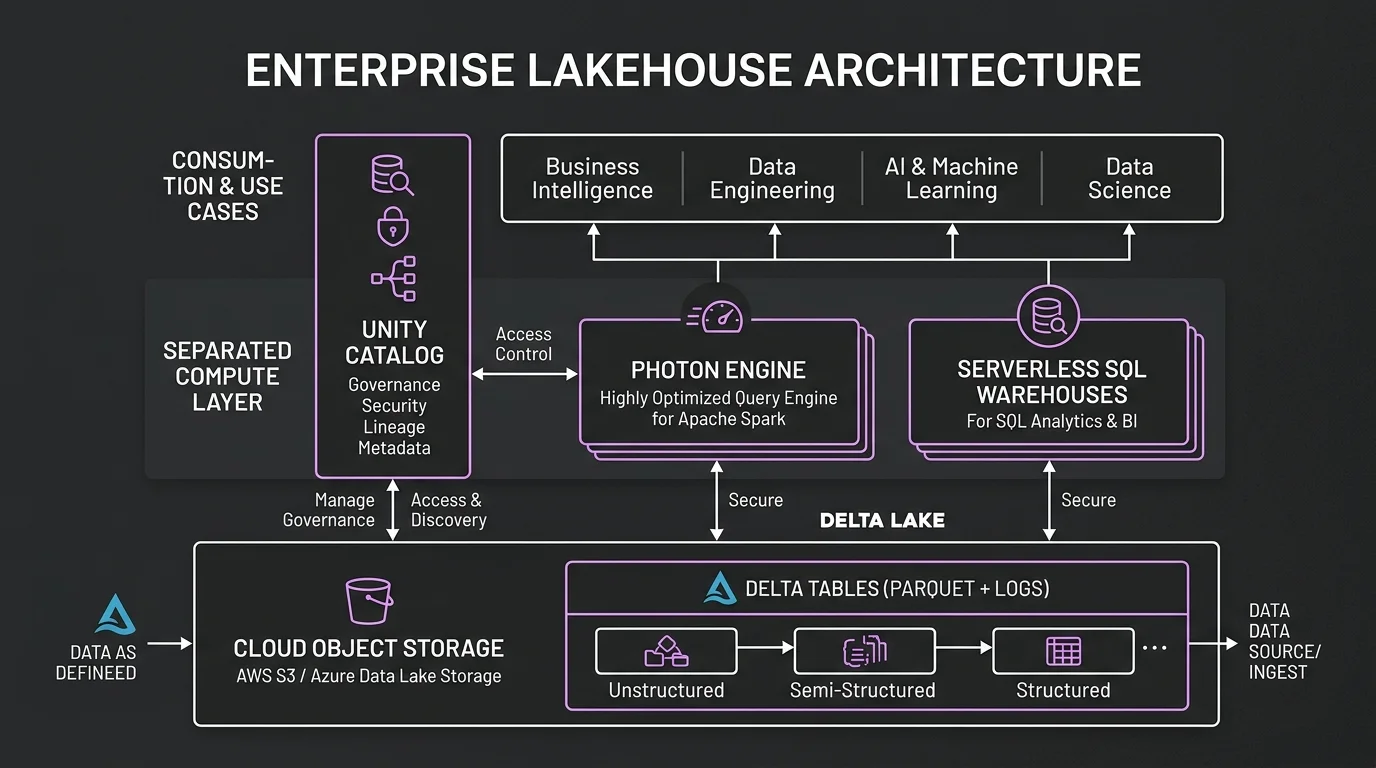
A lakehouse combines the query performance and governance of a traditional data warehouse with the flexible, open-format, low-cost storage of a data lake. For a UK enterprise, this matters for three concrete reasons:
Where this differs from the generic Databricks pitch: most vendor content treats migration as a technical exercise. For a UK enterprise, the real gating factors are usually data residency commitments, existing Azure Enterprise Agreement spend commitments, and whether your compliance team has already signed off on a specific cloud region. Any migration plan that doesn't address those three things first isn't a real migration plan yet.
Most legacy UK data warehouses were built on the classic three-tier pattern:
This works, but every schema change is a migration project, every new data source is a new ETL pipeline, and every scaling event means a licensing conversation.
In a lakehouse, the equivalent stack is:
This is the part most vendor pages skip. A realistic migration touches:
| Component | What Changes |
|---|---|
| Schema | Star schemas generally port over conceptually; physical DDL needs rewriting |
| ETL/ELT jobs | Most legacy ETL tools need reconfiguration or replacement (dbt, Airflow, or native Databricks workflows) |
| BI layer connections | Power BI / Tableau connections need re-pointing and often semantic layer rework |
| Access control | RBAC needs to be rebuilt in the new catalog, not just copied |
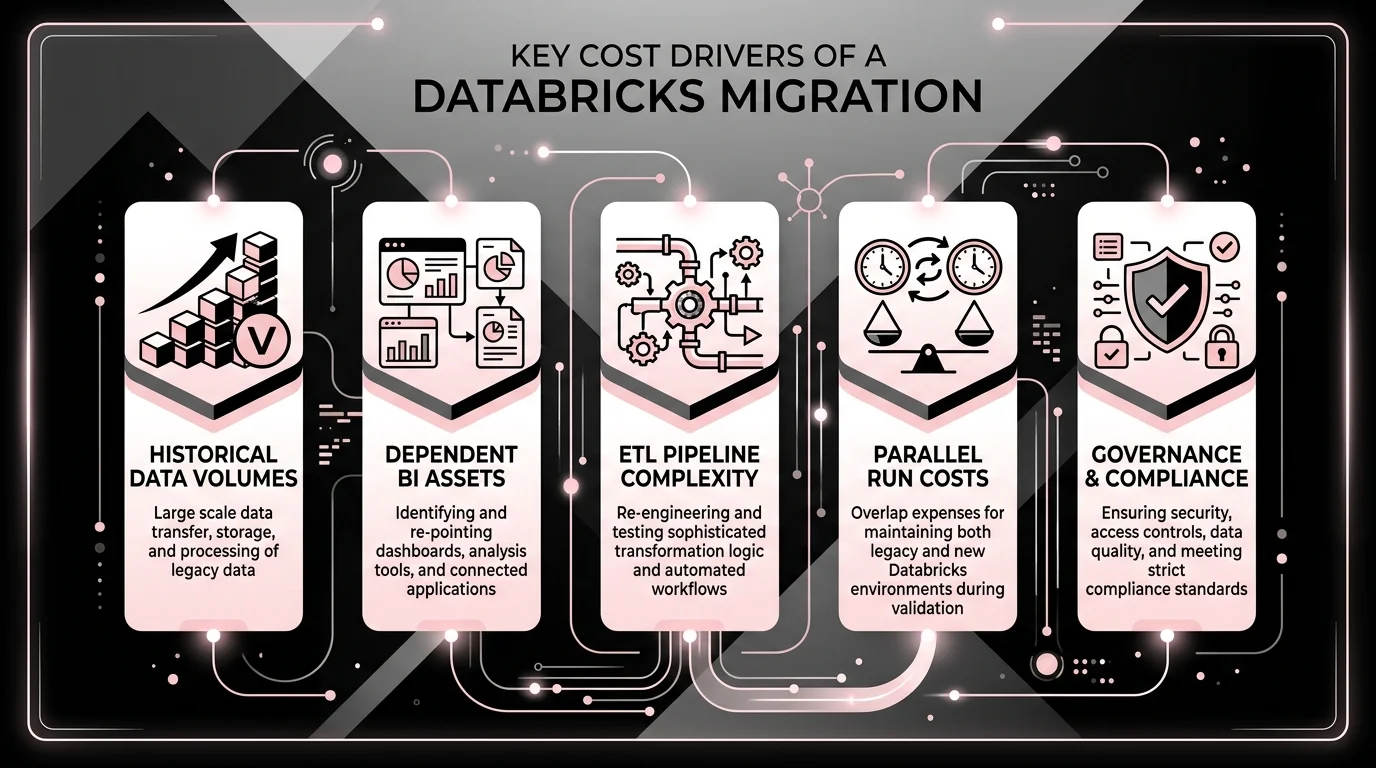
| Historical data | Bulk load strategy depends heavily on volume — this is usually the single biggest cost driver |
Most public cost comparisons stop at "lakehouse storage is cheaper than warehouse storage," which is true but incomplete. In practice, UK enterprise migration cost is driven by:
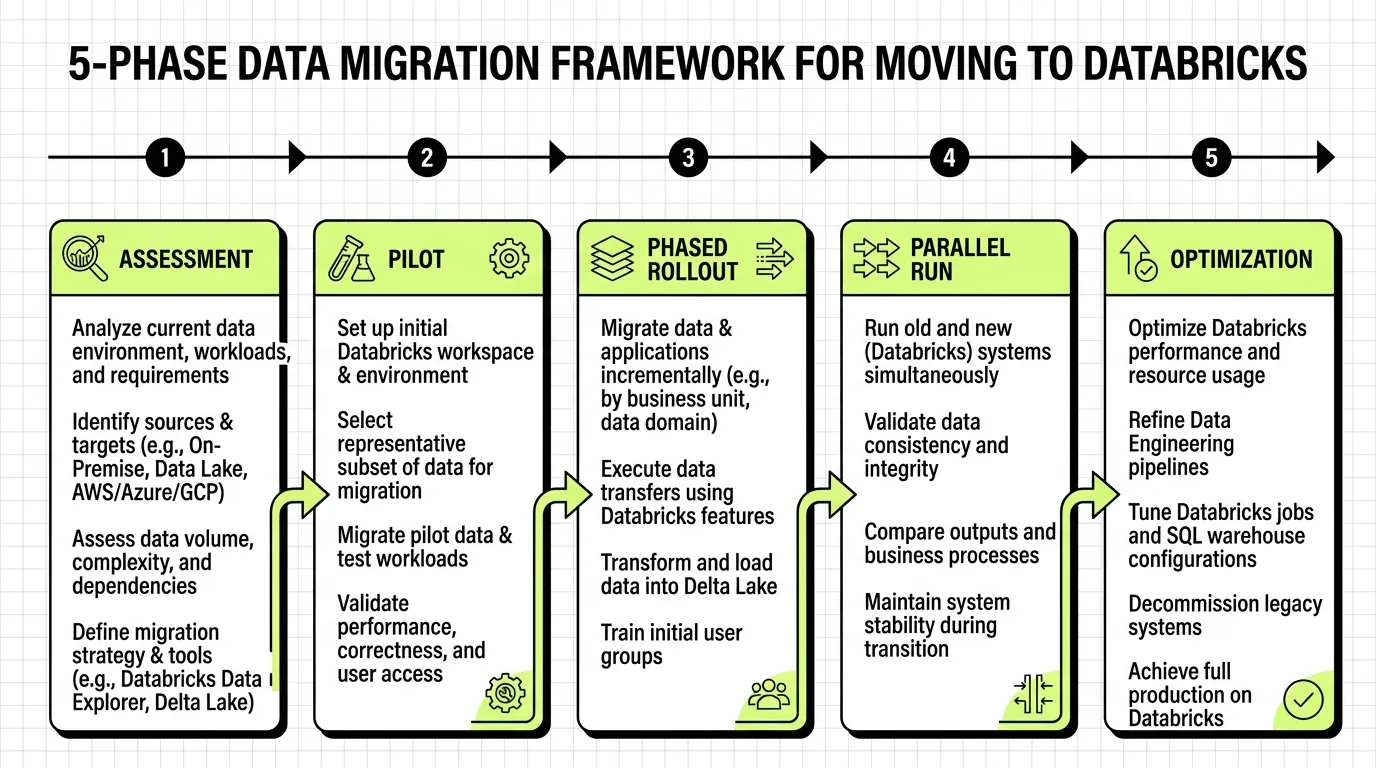
Inventory source schemas, ETL jobs, BI dependencies, and current licensing commitments. Identify which workloads are migration-ready versus which need re-architecture first.
Migrate one bounded domain — typically the least business-critical subject area with a real production workload — end to end, including BI re-pointing and governance rebuild. This is where cost and timeline assumptions get validated or corrected.
Migrate remaining domains in priority order, typically starting with the highest-volume, lowest-complexity workloads to build momentum before tackling the hardest dependencies.
Run both systems in parallel against a defined reconciliation window, then decommission the legacy system once BI and compliance sign-off is complete.
Post-migration tuning: partitioning strategy, predictive optimization configuration, and cost monitoring against the baseline established in Phase 1.
Healthcare / Life Sciences — HL7 and other semi-structured clinical data formats are a genuine lakehouse advantage over traditional warehouses, but data residency and NHS Digital / DSPT compliance requirements need to be scoped before storage region decisions are made, not after.
Financial Services — Real-time fraud detection use cases benefit from the ML-native architecture, but FCA data handling requirements typically mean governance rebuild is the long pole in the migration timeline, not the data movement itself.
Retail — Seasonal concurrency spikes (Black Friday, Boxing Day) are the clearest ROI case for serverless compute — you stop paying for infrastructure sized for December year-round.
A single-domain pilot typically runs 6–12 weeks; a full enterprise migration usually spans 6–18 months depending on BI dependency count and governance complexity.
No — Databricks runs natively on AWS, Azure, and GCP, and most UK enterprises migrate within their existing cloud commitment rather than switching providers.
Governance and access-control rebuild is the most commonly underestimated line item, followed by the parallel-run period where both old and new systems are running simultaneously.
Yes — a domain-by-domain phased rollout is the standard approach and significantly reduces risk compared to a single cutover.
The architecture supports GDPR-compliant configurations (encryption, access control, data lineage tracking), but compliance depends on how governance is configured, not the platform alone — this should be validated during the assessment phase, not assumed.
Speak directly with an independent specialist. Get an honest, technical roadmap without the corporate sales pitch.
Book a Workload Assessment with Cyfra Dane